Not so long ago, choosing a chainsaw was easy. If you wanted real cutting power, you bought a gas-powered model and accepted the noise, the fumes and the occasional battle with the starter cord. Electric saws existed, but they were seen as light-duty tools for trimming a few branches near the house.
That picture has changed a lot. Battery technology has improved dramatically, and today’s electric chainsaw can handle jobs that would have been unthinkable for a cordless tool a decade ago. Meanwhile, gas-powered saws have become lighter, cleaner and easier to start. For homeowners, the choice is no longer obvious. It depends on your property, the jobs you do, how often you cut and how much maintenance you’re willing to take on. Here’s a practical comparison to help you decide.
The Three Main Options
Before comparing, it’s worth clarifying what’s on the table. There are really three types of saws for home use:
- Gas-powered saws, running on a two-stroke engine and a fuel-oil mix.
- Corded electric saws, plugged into a wall outlet through an extension cord.
- Battery-powered saws, running on rechargeable lithium-ion batteries.
Corded and battery models share many traits, but they’re quite different in practice, so they’re worth keeping in mind separately.
Power and Cutting Performance
Gas models still lead when it comes to raw power. With engines typically between 35cc and 60cc for home use, they deliver strong, sustained torque that chews through thick hardwood logs without slowing down. They also accept longer bars, often 16 to 20 inches, which makes them better suited to larger trees.
Battery saws have closed much of the gap. High-voltage models can cut through logs of a respectable diameter and handle most garden tasks with ease. However, they can slow down in dense hardwood or during long, continuous cuts, and bars usually top out around 14 to 18 inches.
Corded electric saws offer consistent power as long as they’re plugged in, but generally sit below good battery and gas models in cutting performance.
Bottom line: for pruning, limbing and small to medium logs, electric is often enough. For big trees, frequent firewood cutting or hardwood, gas still has the edge.
Runtime
A tank of fuel lasts a long time, and refueling takes seconds. For long cleanup sessions or a day of firewood cutting, gas saws simply keep going.
Battery saws are limited by battery capacity. Depending on the battery size and the type of wood, you might get anywhere from a few dozen cuts to a solid session of work, but heavy jobs drain batteries quickly. Many users buy a second battery to swap while the first one charges.
Corded saws run indefinitely, but only as far as the cord reaches.
Mobility and Convenience
Here, battery saws shine. They’re cordless, quick to grab and ready to cut at the push of a button. No fuel to mix, no cord to drag around.
Gas saws are just as mobile, and arguably more so for large properties, since you can carry extra fuel anywhere. But starting them takes more effort, especially when cold or after a long period of storage.
Corded saws are the least convenient. The cord limits your range, can tangle in branches and must be kept away from the chain at all times.
Weight and Handling
Electric saws are generally lighter, especially compact battery models. This makes them easier to handle for pruning, overhead cuts from the ground and long sessions without fatigue. They also tend to vibrate less.
Gas saws are heavier, particularly with a full tank and a longer bar. Modern anti-vibration systems help, but they’re still more tiring to use for extended periods.
Noise and Emissions
Gas saws are loud, often well over 100 decibels, which requires hearing protection and may bother neighbors. They also produce exhaust fumes, so they should never be used in enclosed spaces.
Electric saws are much quieter, though still loud enough that hearing protection is recommended. They produce no direct emissions, which makes them pleasant to use in residential areas, near the house or early on a weekend morning. Some communities also have noise restrictions that make electric models a more neighbor-friendly choice.
Maintenance
This is a major difference. Gas saws need regular care: mixing fuel at the correct ratio, cleaning or replacing the air filter, checking the spark plug, maintaining the carburetor and preparing the engine for storage. Old fuel can gum up the carburetor if the saw sits unused for months.
Electric saws need far less. You still have to sharpen and tension the chain, keep the bar oiled and clean the saw after use, but there’s no engine to tune or fuel to manage. For battery models, proper battery storage is the main concern.
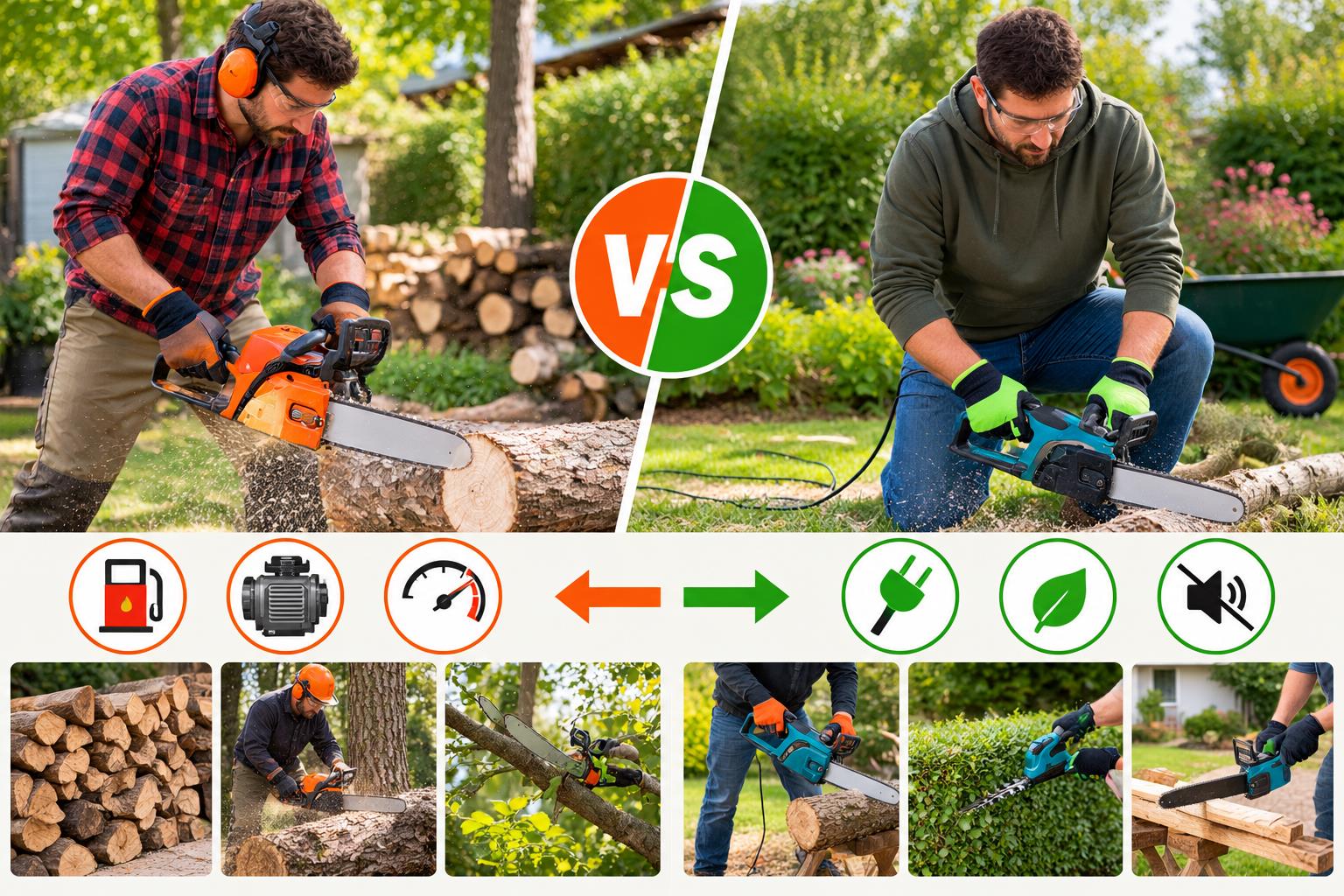
Comparing Gas vs Electric Chainsaw for Home Use
When weighing gas vs electric chainsaw for home use, it helps to look at the trade-offs side by side.
| Gas | Battery electric | Corded electric | |
| Power | Highest | Good to very good | Moderate |
| Runtime | Long, refuel in seconds | Limited by battery | Unlimited, tied to cord |
| Mobility | Excellent | Excellent | Limited |
| Weight | Heaviest | Light to moderate | Light |
| Noise | Very loud | Quieter | Quieter |
| Emissions | Exhaust fumes | None directly | None directly |
| Maintenance | Highest | Low | Low |
| Starting | Pull cord | Push button | Push button |
| Upfront cost | Moderate to high | Moderate to high with batteries | Lowest |
No option wins every category. The best choice depends on which factors matter most to you.
Cost Over Time
Corded electric saws are usually the cheapest to buy. Battery saws can be affordable as bare tools, but batteries and chargers add significantly to the cost, unless you already own batteries from the same tool brand. Gas saws range widely, from budget models to premium ones.
Running costs also differ. Gas saws require fuel, two-stroke oil, spark plugs, air filters and periodic servicing. Electric saws use electricity, which is cheap, but batteries eventually lose capacity and need replacing after several years.
For occasional users, electric models often end up cheaper over time. For heavy users, a well-maintained gas saw can be very economical.
Safety Considerations
All chainsaws are dangerous, regardless of power source, and require proper protective gear: chainsaw chaps, a helmet with face shield and ear protection, gloves and sturdy boots.
That said, there are a few differences. Electric saws stop the chain almost instantly when you release the trigger, while gas saws have an idle mode where the engine keeps running. Lighter electric saws are often easier to control, which can reduce fatigue-related mistakes. Gas saws carry additional risks related to fuel handling and hot engine parts. Corded saws add the risk of cutting the cord, so it must be managed carefully.
Every saw should have a chain brake, a chain catcher and, ideally, a low-kickback chain.
Which One Fits Your Situation?
Choose electric (battery) if:
- you have a small to medium garden;
- you mostly prune, trim and handle storm debris;
- you cut only occasionally;
- you value quiet operation and low maintenance;
- you already own batteries from the same brand.
Choose corded electric if:
- you work close to the house;
- your jobs are light and infrequent;
- you want the lowest upfront cost.
Choose gas if:
- you have a large property or wooded land;
- you cut firewood regularly or deal with large trees;
- you need long, uninterrupted sessions;
- you work far from power sources;
- you’re comfortable with engine maintenance.
Some homeowners end up with both: a light battery saw for quick pruning near the house and a more powerful gas model for heavy cutting.
Matching the Tool to the Work
The debate isn’t about which technology is better in general, but which one suits your home and your habits. Electric saws have become genuinely capable, quiet and easy to live with, making them the right choice for many gardens. They’re especially appealing for occasional users who want a tool that starts instantly and needs little care.
But for big jobs, long sessions and serious wood cutting, a gas chainsaw remains hard to beat. Think honestly about the work you’ll actually do, and you’ll find the saw that makes those jobs easier, safer and more enjoyable.