Installing a Level 2 charger at home can turn daily driving into a simple plug-in routine. Still, the best setup in Vancouver, WA depends on a few non-negotiables: how much power your service can safely deliver, where the charger lives relative to your parking, and what your local authority requires to approve the work. This article walks through the practical decisions that matter most. You will see how service amperage limits circuit size, why charger placement affects wire gauge and voltage drop, and how permits and inspections support a code-compliant, long-lasting installation.
Assess Your Panel Capacity and Do a Load Calculation
If you are exploring Vancouver, WA residential electric car charger installation, a licensed electrician will start by checking your main service rating and running a dwelling load calculation. EV charging is treated as a continuous load, so a charger that draws 32 amps of current typically runs on a 40-amp, 240-volt dedicated circuit. On a 100-amp service with an electric range and heat pump, that added load may push the panel near its limit; on a 200-amp service, you often have more headroom for a 40- or 50-amp breaker. The calculation, not guesswork, tells you whether a new 240-volt circuit can be added as-is, needs a smaller breaker, or triggers a service upgrade discussion.
When capacity is tight, you still have options. Some homeowners choose a lower-amp EVSE that charges overnight on a 30- or 40-amp circuit. Others add a subpanel to simplify branch circuits or use a listed load-management device that sheds nonessential loads when the car is charging. These strategies can keep charging reliable without replacing the meter base or upgrading to a larger service, though they require careful configuration and inspection to meet code.
Match Circuit Amperage and EVSE Type to Real-Life Charging
Not every driver needs a 48-amp, hardwired EVSE. A commuter who adds 25 miles a day can often recover that range with a 32-amp Level 2 unit on a 40-amp circuit, while a rideshare driver turning multiple trips might want a 50- or 60-amp circuit to support faster charging between shifts. There is a trade-off: higher amperage delivers more kilowatts to the vehicle, but it also uses more panel capacity and thicker conductors, and it may require a longer permit review if a service upgrade is involved. Buying the largest charger without verifying its capacity is a common mistake that can lead to redesigns or delays.
Decide early between a NEMA 14-50 receptacle and a hardwired EVSE. A receptacle offers flexibility for portable chargers and future RV use, but many jurisdictions require GFCI protection on garage receptacles, which can cause nuisance trips with some EVSEs. Hardwiring a wall-mounted unit reduces plug wear, can avoid receptacle-related trips, and is often preferred for 48-amp models that require a bigger conductor and a two-pole breaker anyway. Coordinate the charger’s listed maximum output, the breaker size, and the copper or aluminum wire gauge so the entire branch circuit matches end to end.
Place the Charger to Shorten Runs and Protect the Equipment
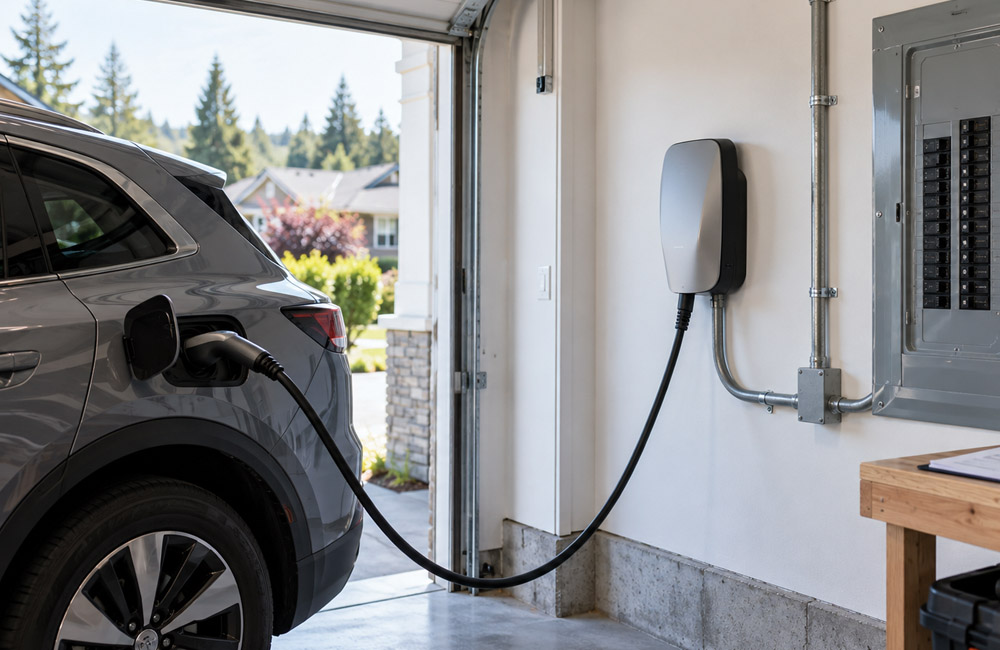
Charger placement is more than a matter of convenience; it affects voltage drop, conduit routing, and the EVSE’s lifespan outdoors. Mount the unit so the cord reaches the charge port without crossing a walkway or repeatedly straining the connector; most cords are 18 to 25 feet long. Keeping the branch-circuit run shorter reduces voltage drop, which becomes a real factor on long garage-to-driveway pulls. If a long run is unavoidable, an electrician may upsize conductors to maintain efficient charging and meet performance recommendations.
For outdoor installations, use an EVSE rated for wet locations and choose enclosures with weather protection (often NEMA 3R or better). Seal penetrations, support conduits with proper straps, and add a drip loop at the unit. Detached garages usually require trenching and a buried conduit from the house panel, and the burial depth and conduit type must comply with local code. In one common scenario, placing the EVSE on the exterior wall nearest the driveway cuts 40 feet of conduit, eliminates a turn across the patio, and avoids upsizing the wire to reduce voltage drop.
Permits, Inspection, and Utility Coordination in Vancouver
In Southwest Washington, a new 240-volt branch circuit for EV charging typically requires a permit and inspection through the local authority having jurisdiction. Expect the inspector to look for a dedicated two-pole breaker with proper labeling, GFCI where required, correct conductor size, and secure cable or conduit routing. If the load calculation indicates a service upgrade, your electrician will also coordinate with the utility on meter work and any service-entrance changes. Good contractors prepare a clear one-line diagram and site plan, which helps permitting move smoothly and reduces the chance of a correction notice.
Avoiding Common Mistakes in Older Garages and Driveways
Several pitfalls crop up in older homes. Using a dryer receptacle with an adapter may seem convenient, but shared circuits, wrong cord caps, and missing GFCI protection make it unsafe and noncompliant. Running NM-B cable unprotected across a garage wall invites damage where conduit is required. Another frequent issue is placing the EVSE so the cord must drape over a vehicle’s hood to reach the charge port, which accelerates connector wear and tempts extension-cord use. All of these problems are preventable by dedicating the right breaker, protecting conductors with raceway where exposed, and locating the unit within a natural cord sweep to the parking spot.
Two real-world examples illustrate the value of planning. In a 1950s bungalow with a 100-amp service, downsizing the EVSE to a 32-amp unit allowed overnight charging on a 40-amp circuit without upgrading the service, and the wall mount near the front of the garage kept the run short. In a townhouse with outdoor parking, choosing a weather-rated, hardwired EVSE on a pedestal at the assigned space avoided crossing the sidewalk and halved the conduit length, reducing voltage drop. In both cases, permits and inspection confirmed the details were correct before routine charging began.
Thoughtful EV charger installs hinge on three decisions: confirm your panel and load calculations support the circuit you want, choose an EVSE and breaker size that match real-world charging patterns, and place the equipment to minimize wire length and weather exposure. With permits and inspections handled up front, you get a dedicated, code-compliant branch circuit, a charger that fits your daily routine, and an install that stays reliable as vehicles and charging habits evolve. A short planning session with a licensed electrician can translate those decisions into a safe, future-ready setup for your Vancouver home.