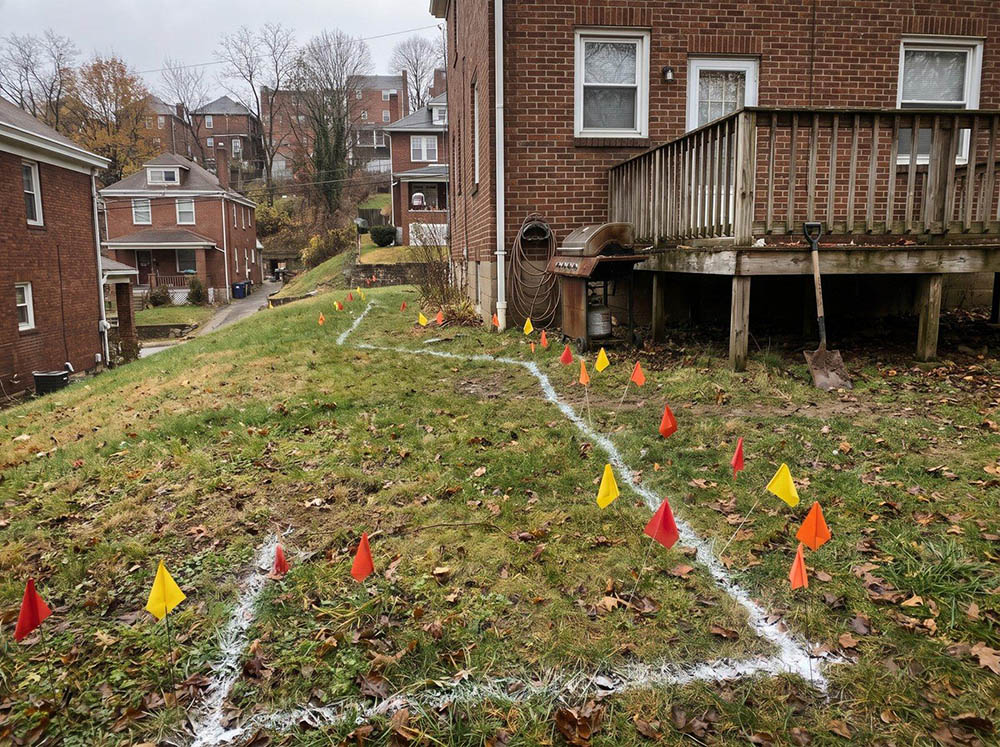
White paint and colored flags mark public utility lines in a sloped Pittsburgh backyard before a project begins
Most people know the rule: call 811 before you dig. You’ve probably made the call before planting a tree or setting fence posts, but it covers less ground than it sounds like. It brings out the utility companies to mark their own lines, and nothing more. Whatever sits on your side of the meter, such as a sewer lateral, a buried feed to the garage, or irrigation wiring, stays unmarked. For a weekend deck or fence project in an older Pittsburgh neighborhood, that gap is where the expensive surprises live.
What Utility Locating Really Means in Pittsburgh
In Pennsylvania, you must contact the state’s One Call system at least three business days before you dig. The call is free, and it applies to homeowners as much as to contractors. Have your county, municipality, and street details ready, and describe exactly where the work will happen. Marking the dig area in white paint ahead of time helps the locators find the right spot on the first visit.
Each utility then sends a crew to flag its own buried lines with paint or flags. That’s the whole job. For projects that cross property lines or run past the meter, utility locating services in Pittsburgh, PA can trace the lines the public system leaves out.
Before scheduling your project, it’s also worth understanding what the law requires once you’ve submitted a locate request. Pennsylvania 811 explains the legal requirements of the state’s One Call law, including the steps to follow before excavation begins. A quick review can help you avoid missing something important before the first shovel hits the ground.
Why Pittsburgh Yards Hide More Than You Think
Pittsburgh is a city of hills, old housing stock, and decades of layered repairs. A lot with a 1920s foundation may have gas, water, and sewer service lines replaced at different times, by different crews, sometimes without anyone updating a record. Steep lots add another wrinkle. Soil moves and drainage changes, so a line that was shallow when it went in can end up in a very different position today.
The national picture backs up the caution. The Common Ground Alliance’s 2025 DIRT analysis covered 221,717 unique damage reports, and the group’s damage index hit a record high, according to Trenchless Technology’s summary of the report. Not contacting 811 remained the leading root cause. Those aren’t just contractor problems; plenty of the damage starts with a homeowner and a rented auger.
What 811 Doesn’t Cover

A technician scans a driveway with a ground-penetrating radar cart to trace private lines
Here’s the part most guides skip. 811 doesn’t mark private lines. As Diggers Hotline explains in its homeowner safety guide, privately owned utilities often require separate locating services. That includes sewer laterals, water lines to a detached garage, electric feeds to a shed, gas lines to a grill or fire pit, irrigation, and landscape lighting.
Private locators fill the gap with two main tools. Ground-penetrating radar reads changes in the soil to spot pipes, tanks, and voids, including non-metallic ones. Electromagnetic locators pick up metallic lines and cables that carry a signal. Neither is perfect. Soil type, moisture, and clutter all affect the results, which is why a good locator will often combine methods and tell you how confident they are.
Hire one when the project is deep, wide, or near the house: a pool, a retaining wall, a new drainage run, a driveway replacement. If you’re only setting a mailbox post, the standard call is probably enough. But “probably” is the word to watch on a lot you don’t know well.
Reading the Marks and Digging Safely

Hand digging beside a flagged line keeps a small project from becoming a repair bill
Once the locators finish, the marks follow a color code that’s consistent across the country: red for electric, yellow for gas and oil, orange for communications, blue for water, and green for sewer. Pink marks temporary survey points, and white outlines your planned dig area. Take photos of everything before the paint fades.
The marks are only a starting point. Once the locators leave, responsibility for protecting those marks falls to whoever is digging. Marked line locations are approximate, so hand dig close to them rather than trusting a machine, and expose the line before going further. If the paint gets washed out or scraped away, request fresh markings. Don’t guess.
Contractors face the same logic at a larger scale. Our post on planning small excavation around utilities covers how wet weather complicates access and scheduling, and Pittsburgh’s rain makes that advice relevant here too. On bigger jobs, we’ve also looked at why concealed-utility inspections belong in the contract rather than in a change order after something breaks.
A Quick Checklist for Homeowners and Contractors
- Call 811 at least three business days before you dig, and have your address details ready.
- White-mark the dig area before the locators arrive.
- Wait for every utility to respond; don’t start with a partial set of marks.
- Check for private lines, and hire a private locator for deep or close-to-house work.
- Hand dig near marks and keep photos of the site before and after.
- Re-call if marks fade or the project area changes.
Treat this list as part of ongoing home upkeep. Our guide to smart property maintenance strategies fits a quick locate-and-document habit right in.
Treat 811 as Step One
Calling 811 is the right first move, and it’s free, so skip it at your own risk. But it protects you from the utilities’ lines only. The pipes and cables you own are your problem, and in a city with as many old yards and hillside lots as Pittsburgh, they’re often the ones nobody has mapped. Make the call, then confirm what’s on your side of the line before the first shovel goes in.