Mandy Brixx and Her Creative Beginnings
When I look at Mandy Brixx, born Amanda Brix Toland, I see a performer shaped less by a carefully designed career plan than by an atmosphere of constant music, theater, humor, and imagination. Her story begins in Santa Monica, California, where she grew up as an only child in a household that treated performance almost like a family language.
Her father was a professional pianist, composer, and voice coach. Her mother was a standup comic who became the primary breadwinner through her work. Both parents had met in college before moving to Los Angeles, where they performed at The Horn club in Santa Monica. Their lives gave Mandy an unusual childhood perspective. Music was not simply entertainment in her home. It was work, discipline, expression, and identity.
Her father practiced piano daily, while her mother developed her comedy career and sang and wrote material for her act. What stands out to me is the balance between them. Her father supported his wife’s professional independence, while her mother demonstrated that a woman could build a career around her own talent. Mandy later recognized this environment as an important influence on the way she approached performance and independence.
She attended Santa Monica High School and graduated with the class of 1980. During her school years, she participated in shows, chorus, and Glee Club activities. Around ninth grade, she was cast as Hedy LaRue in How to Succeed in Business Without Really Trying. That experience helped turn a childhood fascination with performing into something more serious.
Her early musical world was wide. Elton John, David Bowie, Led Zeppelin, Broadway musicals, blues, and especially Robert Plant influenced her. She admired Plant’s vocal range and reportedly kept a large poster of him above her bed. She learned by singing along with records, absorbing songs through repetition rather than formal musical notation.
The Go-Go’s gave her another important revelation. Seeing them perform at the Whisky a Go Go around 1980 or 1981 showed her that women could stand on a rock stage with attitude, humor, femininity, and force. That image helped redirect her imagination from conventional acting toward the unruly world of Los Angeles rock.
Mandy studied theater at Santa Monica College, attended the Estelle Harman Actors Workshop, and later went to Sawyer Secretarial School. Acting remained part of her background, but music increasingly offered something she wanted: the ability to create her own identity instead of waiting to be chosen for a role.
Family Influences and Personal Relationships
Mandy Brixx’s family story is unusually important because both of her parents were working performers. Her father was a pianist, composer, and voice coach, while her mother was a standup comedian and politically active woman who supported the family through her career.
| Family member | Known information |
|---|---|
| Father | Professional pianist, composer, and voice coach |
| Mother | Standup comic and primary family breadwinner |
| Siblings | None, Mandy was an only child |
| Former husband | Duff McKagan |
| Children | Mandy has been described publicly as a mother, but detailed information is private |
Her parents’ relationship appears to have given her a particularly strong example of artistic partnership and personal independence. Her mother worked in an era when female comedians had far fewer opportunities, while her father encouraged her professional ambitions. Mandy absorbed those values without necessarily labeling them as feminism when she was young.
Her connection with Duff McKagan became the most publicly documented relationship of her early adult life. McKagan, whose full name is Michael Andrew McKagan, later became internationally famous as the bassist of Guns N’ Roses. Mandy and Duff met through mutual friends within the interconnected Los Angeles rock community.
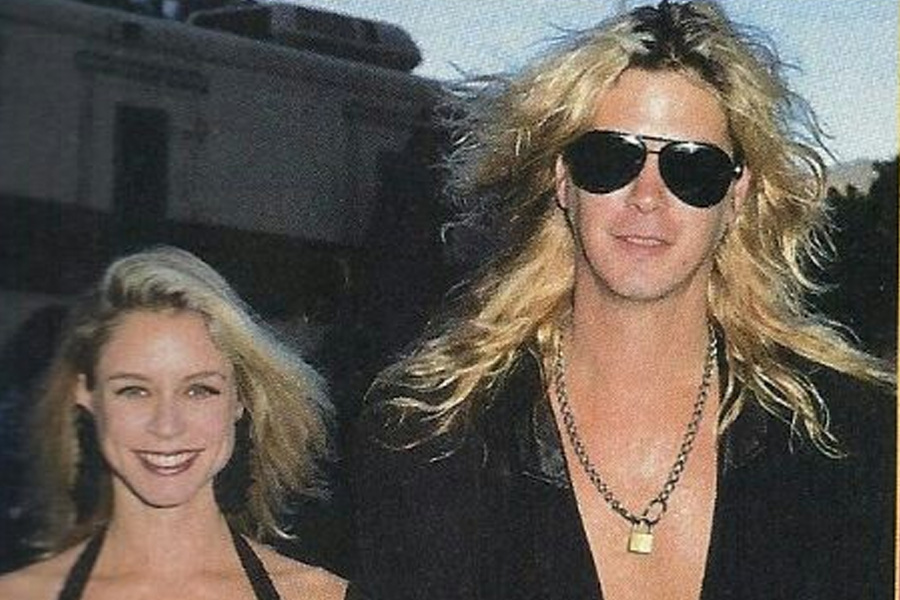
Their relationship developed during the period when the Sunset Strip scene was becoming one of the most visible centers of American rock culture. They married on May 28, 1988. Mandy was also photographed with McKagan at the MTV Video Music Awards on September 6, 1989.
The marriage was relatively brief. Their divorce was finalized on April 1, 1990. They had no children together.
I find it significant that Mandy’s identity cannot really be reduced to being Duff McKagan’s first wife. Their marriage connected her to one of rock’s most famous bands, but she was already building her own career within the same turbulent musical ecosystem. She was a frontwoman, songwriter, actress, and participant in the Sunset Strip community in her own right.
Later in life, Mandy became a mother. Public information about her children, their ages, and their identities remains limited, which reflects the privacy she has maintained for much of her adult life. Public profiles have also associated Amanda Brix Toland with work as a stylist at Anthropologie. Beyond these fragments, she has chosen to keep much of her later family life away from public attention.
Mandy Brixx and the Wild Energy of the Sunset Strip
The Lame Flames, a vibrant and purposefully provocative band associated with the quirky underground culture of the Sunset Strip, introduced Mandy to the Los Angeles rock scene.
While in the Estelle Harman Actors Workshop, she got to know Lisa Curland. After Lotus Lame and the Lame Flames’ original singer had left, Curland went up to her. Mandy took advantage of the chance practically right away.
Conventional rock seriousness was not the foundation of the Lame Flames. Comedy, camp, theatricality, raunchiness, and exaggerated femininity were all incorporated into their concept. Funk recordings and novelty performances had an impact on the original material, giving the band a personality more akin to theatrical rock comedy than traditional hard rock.
Mandy was a perfect fit for the idea. She was able to treat songs as characters and performances rather than just vocal workouts since she brought acting instincts to the stage.
Lisa Curland emerged as a key partner. Ann McLean and Clayton Verbinski were among the other members, and Iris Berry rose to prominence in a later stage. Iris and Mandy had a great creative and funny rapport.
The trio met several performers from the Los Angeles scene and shared stages with them. One moment, their performances can be lighthearted, and the next, they might be fiercely dramatic. Because The Lame Flames were seen as something different from the typical bands vying for recognition, Mandy recalled the environment as both competitive and surprisingly welcoming.
One particularly notable episode featured a performance by Nikki Sixx and the LA Guns. In another, Queen’s “Tie Your Mother Down” was jokingly rewritten as “Tie Your Boyfriend Down.” The cheeky atmosphere that enveloped Mandy’s early career is captured in those instances.
She also made a brief cameo as an extra in Less Than Zero and performed some commercial work, such as a Wendy’s commercial. Although there were acting chances, she had greater control over her appearance, material, humor, and stage character in the band setting.
Pink Sabbath and Amanda Jones
After or alongside her Lame Flames years, Mandy continued exploring music through Pink Sabbath. The name could easily lead to assumptions about cover versions, but the group was not a Pink Floyd or Black Sabbath tribute act.
Pink Sabbath brought together Mandy, Iris Berry, guitarist James McCrone, bassist Dawn Laureen, and drummer Eric Blitz. The band performed in the same broad Los Angeles rock network that had shaped Mandy’s earlier work.
One notable performance was connected with a Hollygrove Orphanage benefit at the Roxy. The event included other prominent figures from the era, including Henry Rollins and River Phoenix. For Mandy, these performances placed her in the middle of a remarkable period when punk, metal, alternative rock, glam, comedy, and Hollywood nightlife constantly overlapped.
Another chapter arrived with Amanda Jones, a band she fronted with Jeff Drake of The Joneses. Their history was personal as well as musical. Mandy had written her first song, “Bedroom Eyes,” about Drake earlier in her life, and they eventually collaborated professionally.
Her musical path during these years was not a straight line. It was more like a winding road through clubs, rehearsals, friendships, relationships, acting opportunities, and changing ambitions. Mandy has described herself as someone who did not always make highly conscious career decisions. She followed opportunities and instincts, sometimes recalibrating when one direction no longer felt right.
Mandy Brixx and Guns N’ Roses
Mandy’s connection with Guns N’ Roses is one of the reasons her story remains familiar to rock fans decades later.
She had already entered a relationship with Duff McKagan when she appeared in the band’s “Sweet Child o’ Mine” music video. The production involved a long overnight shoot built around a Hollywood party atmosphere. Mandy was one of the women featured in the video.
The appearance became a small but permanent piece of rock history. “Sweet Child o’ Mine” grew into one of Guns N’ Roses’ defining songs, and its video became one of the most recognizable visual documents of the band’s rise.
For Mandy, however, the video was not simply a brush with celebrity. It was part of her actual life at the time. She was already living within the Los Angeles music scene, performing with bands, maintaining friendships among musicians, and dating McKagan.
That distinction matters. Looking backward from the enormous success of Guns N’ Roses can make the era seem carefully choreographed. Mandy’s recollections suggest something much messier and more spontaneous. Musicians, actors, artists, club regulars, and aspiring performers moved through the same small network, often without knowing which names would become legendary.
Recalibrating Life Beyond the Spotlight
Mandy started reevaluating her path in the early to mid-1990s. The Sunset Strip years had become less intense, and the music business as a whole was undergoing fast change.
She has said that she is recalibrating her life during this time. She entered a more subdued phase instead of pressuring herself to stick with a specific narrative of her past.
The person who emerges from her story appears to be congruent with that shift. It doesn’t seem like Mandy has ever been fixated on celebrity for its own purpose. The ability to perform, create characters, make people laugh, sing, and produce original work was what drew her in.
She became a mother later in life and mostly left the public rock spotlight. Her personal life is purposefully kept low-key. Photographs, memories of music, archival references, and Sunset Strip memories, on the other hand, preserve her professional history.
Her on-camera interview from 2023 provided an exceptionally intimate glimpse into those years. Instead than portraying herself as a glitzy rock star, Mandy talked warmly about her early years, her family, her friends, music, her faults, her opportunities, and the peculiar spirit of growing up in Los Angeles during a time of intense cultural change.
Mandy Brixx FAQ
Who is Mandy Brixx?
Mandy Brixx, whose name is Amanda Brix Toland, is an American musician and performer associated with the Los Angeles Sunset Strip rock scene of the 1980s. She performed with The Lame Flames, Pink Sabbath, and Amanda Jones and appeared in the Guns N’ Roses “Sweet Child o’ Mine” video.
When did Mandy Brixx marry Duff McKagan?
Mandy Brixx married Duff McKagan on May 28, 1988. Their divorce was finalized on April 1, 1990.
Did Mandy Brixx and Duff McKagan have children?
No. Mandy Brixx and Duff McKagan did not have children together. Mandy has since been described publicly as a mother, but detailed information about her children has remained private.
What bands was Mandy Brixx involved with?
Her best-known musical associations include The Lame Flames, Pink Sabbath, and Amanda Jones. Her work was rooted in the colorful Los Angeles club scene rather than mainstream commercial recording.
Was Mandy Brixx in a Guns N’ Roses video?
Yes. Mandy appeared in Guns N’ Roses’ “Sweet Child o’ Mine” music video during her relationship with Duff McKagan.
What was Mandy Brixx’s family background?
Mandy grew up in Santa Monica as an only child. Her father was a professional pianist, composer, and voice coach, while her mother was a standup comic and the family’s primary breadwinner. Both parents encouraged her interest in performance.
What happened to Mandy Brixx after the Sunset Strip years?
Mandy gradually moved away from the public music spotlight during the 1990s. She later became a mother and maintained a comparatively private life. Public profiles have also associated her with styling work.
Why is Mandy Brixx remembered today?
I think Mandy’s lasting appeal comes from the combination of personal history and cultural timing. She was part of the Sunset Strip before its mythology had fully formed, performing in bands, appearing in one of rock’s most famous videos, and moving through the same creative circles that produced some of the era’s biggest names. Her story offers a view of that world from inside the crowd, rather than from the center of the spotlight.