Storm seasons test more than patience. They test wiring, fuel supply, and the small decisions that determine whether a standby or portable generator will carry your home through a multi-day outage. The smartest path is not “biggest box you can afford” or “whatever fits by the meter.” It is a sequence: define your critical loads, confirm fuel capacity, choose a safe location, and match the transfer method to how you plan to live during an outage. The details below focus on concrete choices Louisiana homeowners face, using clear terms like automatic transfer switch, load shedding, conductor runs, and decibel ratings. Hence, each decision has a practical anchor.
Start With the Loads You Cannot Lose.
List the circuits you truly need: refrigerator and freezer, a 3-ton air conditioner or a heat pump, a well or sump pump if you have one, Wi-Fi and router, key lighting circuits, and a microwave or small cooktop. Running wattage matters, but starting surge drives sizing; a compressor’s locked-rotor amps can briefly demand two to five times its normal current. If you plan to keep one central AC online, ask about a soft-start kit or a load-shedding module that drops the AC for a minute when the water heater elements or oven kick on. For site-specific guidance and to understand local load-planning practices in Lafourche Parish, resources such as Thibodaux Gengatorz Power Systems can help you interpret these variables without guesswork.
Scenario: a single-story home with a 3-ton AC, electric range, and an electric water heater. Instead of chasing a “whole-house” generator, you might power an essentials subpanel: kitchen outlets, fridge, living room lights, primary bedroom, the air handler, and the condenser with load shedding on the water heater. That strategy can let a 14 to 18 kW standby unit carry you comfortably, whereas running every resistance load simultaneously could push you into a larger, louder, and more expensive unit with no real benefit.
Fuel Source and Utility Capacity Shape Your Ceiling
Standby generators typically run on natural gas or propane. Natural gas offers long runtime and no refilling, but your meter’s BTU rating and regulator capacity must support both the generator and existing appliances at the same time. If the meter cannot feed a 20 kW unit at full load while the furnace and range are firing, the generator may sag under load. Propane avoids gas line pressure issues and can deliver steady fuel from a 250- or 500-gallon tank, but refilling during a widespread outage may be unpredictable, and tank placement adds another siting variable.
Pipe length, diameter, and fittings affect pressure drop. A generator located far from the natural gas meter may require a larger pipe or a secondary regulator to keep fuel delivery stable at peak load. Diesel standby systems are common in commercial settings but less typical for homes in this region because of storage and maintenance demands. For portable backup, an inverter generator running on gasoline produces cleaner power for electronics. It is quieter, but you will need safe fuel storage, a stabilizer, and a plan to rotate stock before hurricane season.
Place the Generator for Airflow, Noise, and Flood Risk
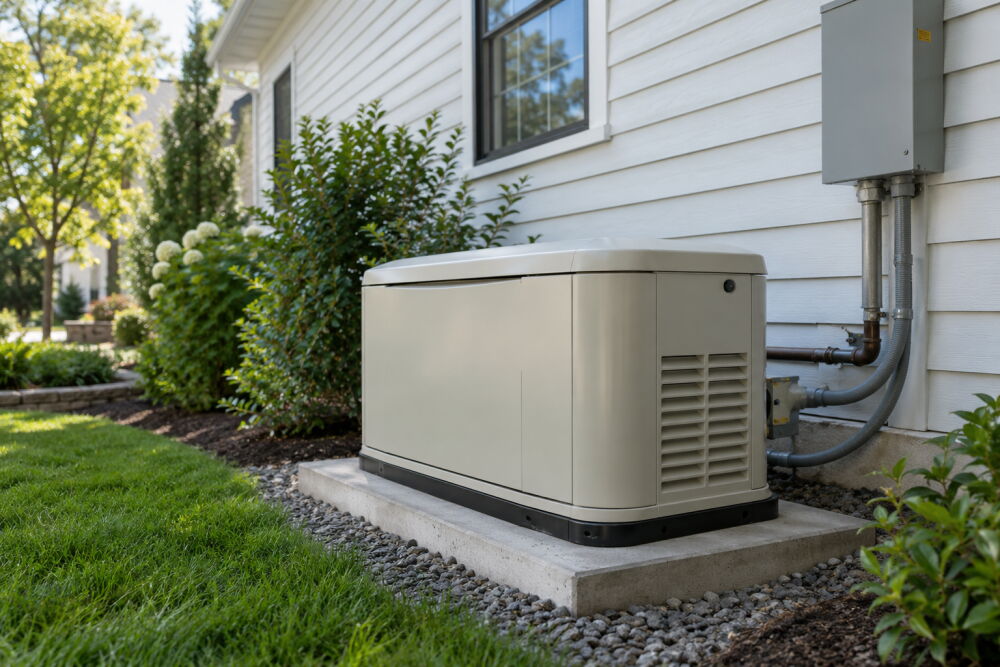
Manufacturers specify clearances from walls, soffits, and openings for exhaust and cooling airflow. Keep the unit away from bedroom windows and fresh air intakes, and orient the exhaust so prevailing winds do not carry fumes into the house. Noise ratings, usually measured at 23 feet, matter to neighbors and to you at night. Placing the generator farther from sleeping areas often reduces perceived noise. Still, longer conductor and fuel runs increase cost and can introduce voltage drop if you don’t adjust wire size appropriately.
In low-lying areas, elevating the generator on a concrete pad or an engineered platform can reduce flood risk and keep the enclosure above standing water after heavy rain. Think through the conduit path back to your main breaker panel and the automatic transfer switch; tight turns around HVAC linesets or a crowded side yard raise installation complexity. Scenario: a narrow side yard holds the gas meter and two bedroom windows. The back corner of the lot might be better for airflow and noise, even if it requires upsizing the gas line and using larger conduit to maintain ampacity and minimize voltage drop.
Choose the Right Transfer Method and Circuit Strategy
An automatic transfer switch (ATS) senses the outage, starts the generator, and shifts your selected loads onto generator power. A service-entrance-rated ATS can replace the main disconnect and feed either the whole house or a dedicated subpanel for essential circuits. Whole-house switching sounds simple, but it can be a trap if you don’t manage big electric heat strips, pool pumps, or an all-electric range. Load shedding modules, smart thermostats with compressor delay, and a prioritized essential panel can keep a smaller generator stable through appliance cycles.
If you prefer a portable generator, a listed interlock kit and a proper power inlet (for example, an L14 30 or 14 50 inlet wired to your panel) allow safe backfeeding without dangerous “suicide cords.” A common mistake is relying on a tangle of extension cords from outdoor receptacles, which bypasses overcurrent protection, ignores hardwired loads like the furnace blower, and creates carbon monoxide hazards when the unit runs too close to the house. Pay attention to neutral bonding and GFCI-protected outlets on portable units; compatibility with your interlock setup and transfer equipment matters for nuisance tripping and safety.
Plan for Maintenance and Long Outages
Standby units should run a weekly exercise cycle to keep batteries charged and confirm readiness, but that routine is only the beginning. Change oil and filters on schedule, keep the enclosure clear of leaves and grass clippings, and test under real load at least once a year to catch weak batteries or a failing regulator before storm season. Store a spare air filter, spark plug, oil appropriate to the manufacturer’s specs, and extra fuses for the ATS. For portable generators, stabilize gasoline, rotate it before hurricane season, and start the engine monthly so the carburetor doesn’t gum up when you need it most.
After any major event, walk the site. Check that the concrete pad is level, vibration isolators are intact, louvers are clear, and conduit seals are tight. If you added a surge protective device at the main panel, verify its indicators. Finally, practice: know how to switch your ATS to utility mode after power is restored, and if you use an interlock, rehearse the off sequence so no one guesses under stress. A little repetition makes the difference between a smooth handoff and a dark, confusing evening.
Every reliable backup setup follows the same logic. First, identify the specific circuits you will protect. Next, confirm whether your fuel source and meter or tank can support that load. Then, place the generator where it breathes, stays out of floodwater, and keeps noise manageable, even if that location requires upsized conductors or a longer gas run. Finally, choose transfer equipment that protects linemen and your home while giving you control over large appliances. Start with a load worksheet and a walk around your property, and you will make decisions that hold up when the lights go out.