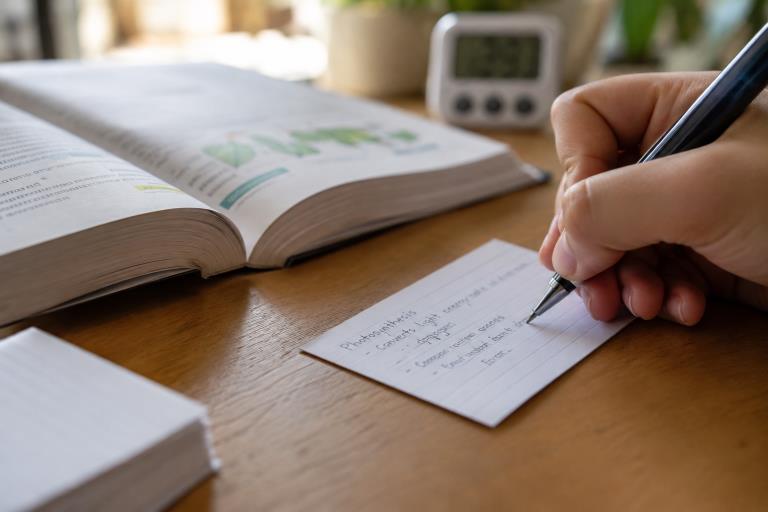
Long study marathons can feel productive, but a shorter routine that makes you retrieve information, check your understanding, and return later is often easier to sustain. The central idea behind the science behind spaced repetition is simple: learning does not have to happen all at once. Repeated, purposeful contact with material can help make it more available when you need it.
This approach can work for students preparing for exams, professionals learning new procedures, and anyone trying to remember a language, skill, or subject more reliably. The goal is not to study in the shortest possible time. It is to make each session active enough to reveal what you know, what you have forgotten, and what deserves another review.
Why Long Cram Sessions Often Feel Better Than They Work
Rereading highlighted notes creates familiarity. Familiarity can be useful, but it is not the same as being able to explain an idea without help. A learner may read a chapter three times, recognize every heading, and still struggle to describe the main argument the next morning. Cramming may help someone feel prepared for an immediate quiz, yet it gives fewer opportunities to practice retrieving information after some time has passed.
Recognition asks, “Do I remember seeing this?” Recall asks, “Can I produce the answer myself?” The second question is usually a more honest test of readiness. Short sessions create room for that test without requiring hours of uninterrupted concentration.
What Makes A Short Study Session Useful?
A productive session has a narrow target. Instead of deciding to “study biology,” choose one task, such as explaining cell transport, solving four equations, or recalling five new vocabulary terms. Then use a simple sequence:
- Read or watch enough to understand the basic idea.
- Put the material aside.
- Answer a question, solve a problem, or explain the concept from memory.
- Check your answer and identify what was missing or mistaken.
- Write down when you will return to the topic.
Fifteen focused minutes can be more useful than a longer period of passive rereading. The difference is not the timer. It is whether the session requires you to think, produce, and correct.
Recall Beats Rereading When The Goal Is Long-Term Memory
Active recall means bringing information to mind without looking at the answer first. Flashcards, practice questions, blank-page summaries, and teach-back exercises all require production rather than recognition. A U.S. Department of Education practice guide recommends using quizzes and active retrieval throughout learning, not only as a final test, because retrieval itself can support durable learning.
Simple Recall Exercises
- Close-the-book recall: Write the main ideas after reading a section.
- Question cards: Turn headings into questions and answer them later.
- Teach-back: Explain the topic aloud as though teaching a beginner.
- Practice problems: Attempt the problem before studying the worked solution.
- One-minute summary: State the idea in a few clear sentences.
How Spacing Changes The Review Process
Spacing means returning to a topic over time rather than treating it as finished after one sitting. The gap does not need to be identical every time. Material that is confusing or repeatedly missed deserves an earlier review. Material recalled accurately and confidently can wait longer before the next check.
A Basic Review Pattern
- First session: Learn the idea and test basic recall.
- The next day: Revisit the weak points without relying on notes.
- Several days later: Use questions, a short quiz, or a blank-page summary.
- About one week later: Mix the topic with related material.
- Later in the month: Do a brief cumulative review.
The exact timing should fit the learner and the deadline. Research on learning techniques has consistently highlighted distributed practice and practice testing as useful approaches across many settings, while also showing that study strategies should be matched to the task. Spreading study sessions out over time is most helpful when it is paired with meaningful questions and a genuine attempt to answer them.
Why The Best Schedule Is Not The Same For Everyone
Prior knowledge matters. A beginner learning unfamiliar terminology may need shorter gaps and more examples than someone reviewing a familiar topic. Difficult subjects may also require guided instruction, discussion, demonstration, writing, or hands-on practice. Exam dates, work demands, and available energy matter too. Consistency is usually more valuable than chasing a perfect interval that does not fit real life.
Feedback Turns Mistakes Into Study Data
Check answers after making a real recall attempt. Feedback confirms correct reasoning and catches errors before they become repeated habits. Keep a small error log: record the question, write the correct answer in plain language, note why the mistake happened, and try the question again later. Connecting the answer to a concrete example can also make abstract material easier to use.
How To Build A Weekly Study Plan
- Break large chapters into smaller skills, concepts, or question sets.
- Schedule the first review soon after initial learning.
- Add recall prompts rather than relying only on notes.
- Give missed or uncertain items extra attention.
- Mix older material into later sessions.
- Use a weekly quiz or summary to check cumulative understanding.
Sample Seven-Day Plan
- Monday: Learn one topic and write five questions.
- Tuesday: Answer those questions without notes.
- Wednesday: Review mistakes and explain the hardest idea aloud.
- Thursday: Combine the topic with related material.
- Friday: Take a short practice quiz.
- Saturday: Review only missed or uncertain items.
- Sunday: Complete a quick cumulative check.
Common Mistakes To Avoid
- Making flashcards that contain entire paragraphs.
- Reviewing only the easiest material because it feels rewarding.
- Looking at an answer before making a real attempt.
- Building a schedule that is too demanding to maintain.
- Confusing quick answers with deep understanding.
- Skipping examples, application, and practice problems.
Final Checklist For Better Review Habits
- Is the goal small and specific?
- Does the session include recall?
- Will you check your answer and learn from mistakes?
- Is another review already planned?
- Are difficult topics getting more attention?
- Does the plan fit your actual week?
Conclusion
Better studying does not always require more hours. It often requires better timing, active effort, useful feedback, and a plan you can repeat. Short sessions can become powerful when they ask you to retrieve what you learned, correct what you missed, and return before the material fades too far from reach.