Losing a single tooth leaves you with two well-established ways to fill the space: a standalone dental implant or a fixed bridge anchored to the teeth on either side. The best path is not simply about speed. It depends on your bone, the condition of the neighboring teeth, and how you want to clean and maintain your bite for years to come. This guide explains how each option works, the daily trade-offs, and real scenarios that often tip the decision so that you can have a focused, productive conversation with your dentist or specialist.
What You’re Replacing: Root, Crown, and the Space That Moves
A missing tooth is more than a gap in your smile. The natural root transmits chewing forces into the jawbone through the periodontal ligament, which helps keep bone dense. Without that stimulation, the ridge can remodel and shrink. Nearby teeth can drift, the opposing tooth may overerupt into the space, and your occlusion can change. If terms like abutment and pontic are new, browsing a provider’s resources can help you visualize parts and steps; for example, this website.
How a Single Implant Differs from a Three-Unit Bridge
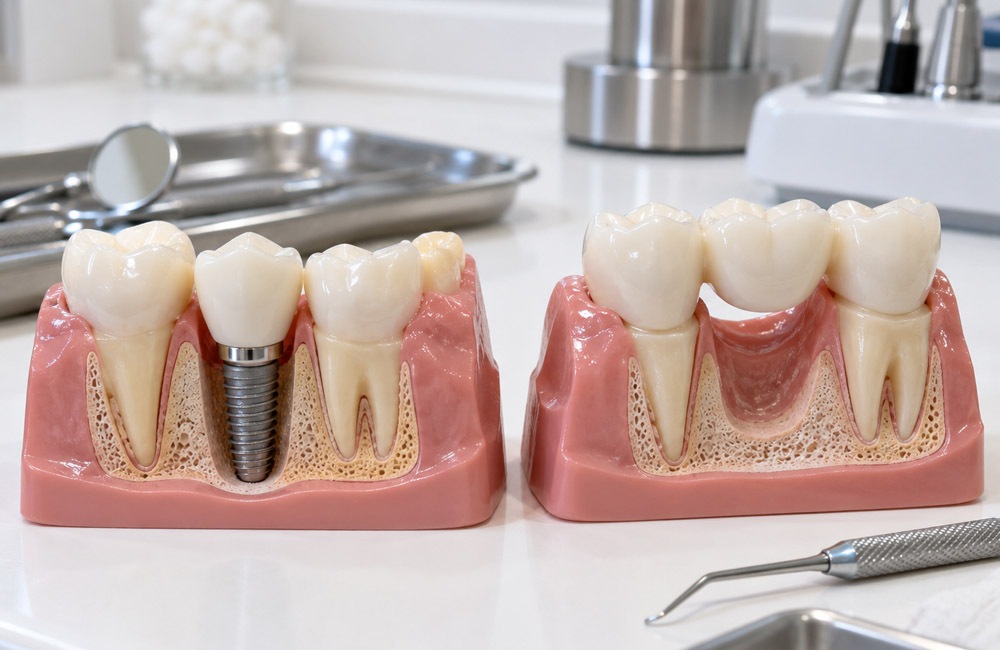
A single dental implant replaces the root with a small titanium or zirconia fixture placed in bone. After osseointegration, a custom abutment is attached, and a crown is secured, either by a tiny screw through the crown or with a controlled amount of dental cement. The adjacent teeth remain untouched. Placement planning often involves a CBCT scan to map bone width, nerve location, and sinus position, and some sites benefit from a bone graft at or after extraction.
A three-unit fixed bridge does not replace the root. Instead, the two neighboring teeth are shaped for retainer crowns that support a middle false tooth called a pontic. This can usually be prepared and temporized in a single visit, with a final bridge cemented shortly after. The tradeoff is irreversible enamel reduction on the abutment teeth, which can raise the lifetime risk of decay at the margins or future root canal therapy if the pulp is close.
Day-to-Day Tradeoffs: Healing Time, Hygiene, and Bite Forces
Implants require a healing window before you can apply full biting loads, so you may wear a temporary partial denture (a “flipper”) and follow a softer diet. Cleaning is similar to a natural tooth, though interproximal brushes can help around the implant crown. A bridge restores chewing immediately once seated, but daily hygiene is different: you need a floss threader or super floss to clean under the pontic, and a water flosser can make this easier. People who clench or grind (bruxism) can overload implants and loosen abutment screws; a night guard reduces those forces. Bridges aren’t immune either, as plaque can stagnate under the pontic and around the retainer margins.
Scenarios That Often Tilt the Decision
Scenario 1: A 28-year-old loses a lateral incisor in a bike fall. Both neighboring teeth are virgin and well aligned. Preserving untouched enamel is a top priority, and the smile line is high. Here, a single implant commonly makes sense because it avoids preparing healthy teeth, supports the papillae between teeth for esthetics, and helps maintain ridge contour. Ask about immediate socket preservation grafting at extraction to protect future implant positioning.
Scenario 2: A 62-year-old needs a cracked upper first molar removed. The second premolar and second molar already have full coverage crowns, and a CBCT scan shows limited bone height under the sinus. In this case, a bridge may be practical because preparing already crowned neighbors is often minimal, and a sinus lift or short implant could add time and surgery. If the patient takes antiresorptive medications or has poorly controlled diabetes that complicates healing, the nonsurgical bridge route may be more predictable in the near term.
Questions to Ask Before You Commit
For an implant: Will I need a bone graft or sinus lift, and how will that affect the timeline and number of visits? Will the crown be screw-retained for retrievability or cement-retained, and how will excess cement be controlled? What temporary will I wear, and what foods should I avoid while the fixture integrates? For a bridge: How much enamel will be removed, and do the abutment teeth already have large fillings or cracks? How will I clean under the pontic day to day? In both cases: Do I need a night guard for bruxism, and what is the long-term maintenance plan, including radiographs and professional cleanings?
Both solutions can serve well for many years when they match your mouth and your habits. If preserving untouched adjacent teeth and bone stimulation matter most, a single implant is often a strong option. If you prefer fewer surgical steps or your neighbors already need crowns, a bridge can be efficient and comfortable. Either way, plan for home care that fits your choice, such as floss threaders and a water flosser under a pontic or interproximal brushes around an implant. Regular exams let your dentist check bite forces, margins, and bone levels so they can correct small issues before they become big repairs.