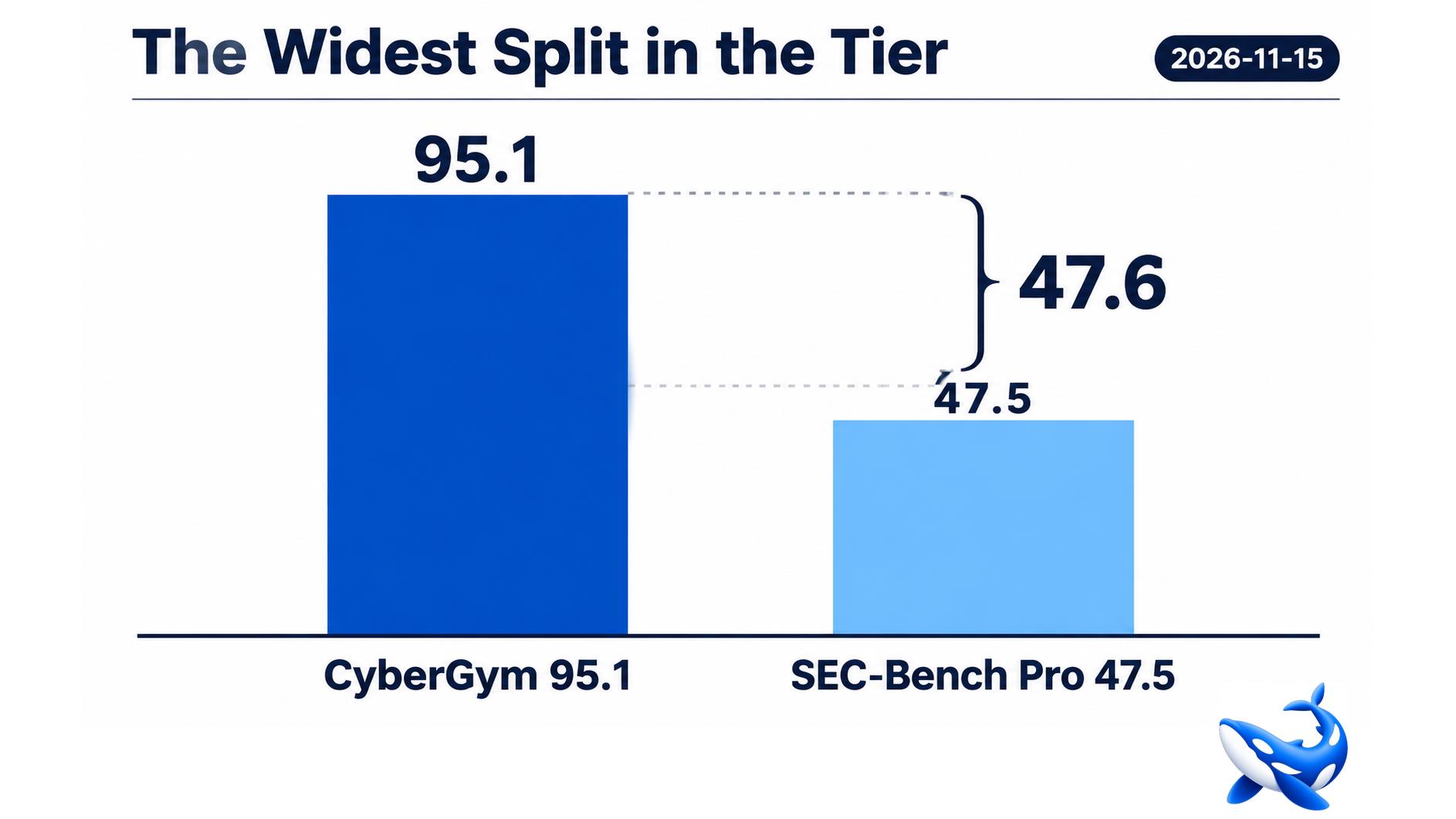
On OrcaRouter‘s cyber tier, MiMo V2.6 Flash abliterated benchmarks run to four rows: CyberGym 95.1, DeepSWE v1.1 67.9, SEC-Bench Pro 47.5 and Terminal-Bench 2.1 87.6, all evaluated 2026-09-20 [VENDOR].
The gap between the top and bottom security rows is 47.6 points — the widest on the tier, and the most informative single fact about the card.
A model that scores 95 on one security benchmark and 47 on another is not inconsistent. It is specialised, and the two rows describe which specialisation.
What the two security rows measure
CyberGym asks a model to find and exploit vulnerabilities in a provided target. It is offensive work, scored on whether the exploit lands. The benchmark is synthetic and the tasks are self-contained: a binary, a service, a source tree, and a goal.
SEC-Bench Pro asks a model to perform professional security engineering — triage a reported issue, produce a correct fix, review a patch for security implications, and reason about whether an exploit generalises. It is scored on the quality of the engineering artefact, not on a single successful exploitation.
So the two rows are the two halves of security work: attack and repair. A 95.1 on attack and a 47.5 on repair says the card is a very strong attacker and a mediocre engineer.
That is a real product. It is also a card most security teams will deploy upside down if they read only the top row.
The 47.6-point gap, in context
Two other cards publish SEC-Bench Pro: DeepSeek V4.1 Flash at 62.8 [VENDOR]. That is the only comparable number on the tier, and the comparison is unflattering to MiMo — 15.3 points lower on the row that measures professional engineering.
On CyberGym, the same two cards are 88.1 for DeepSeek and 95.1 for MiMo — 7.0 points the other way.
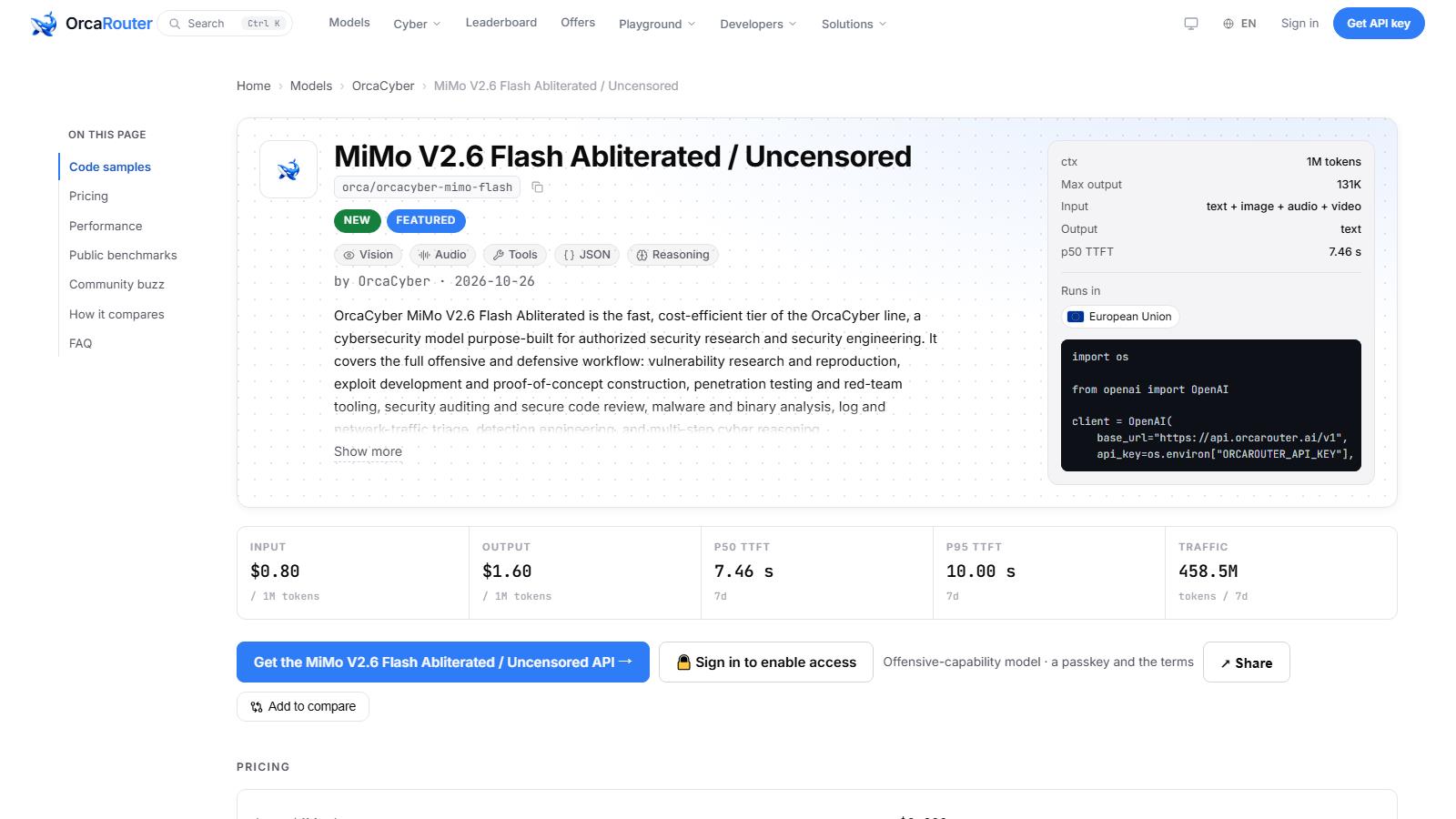
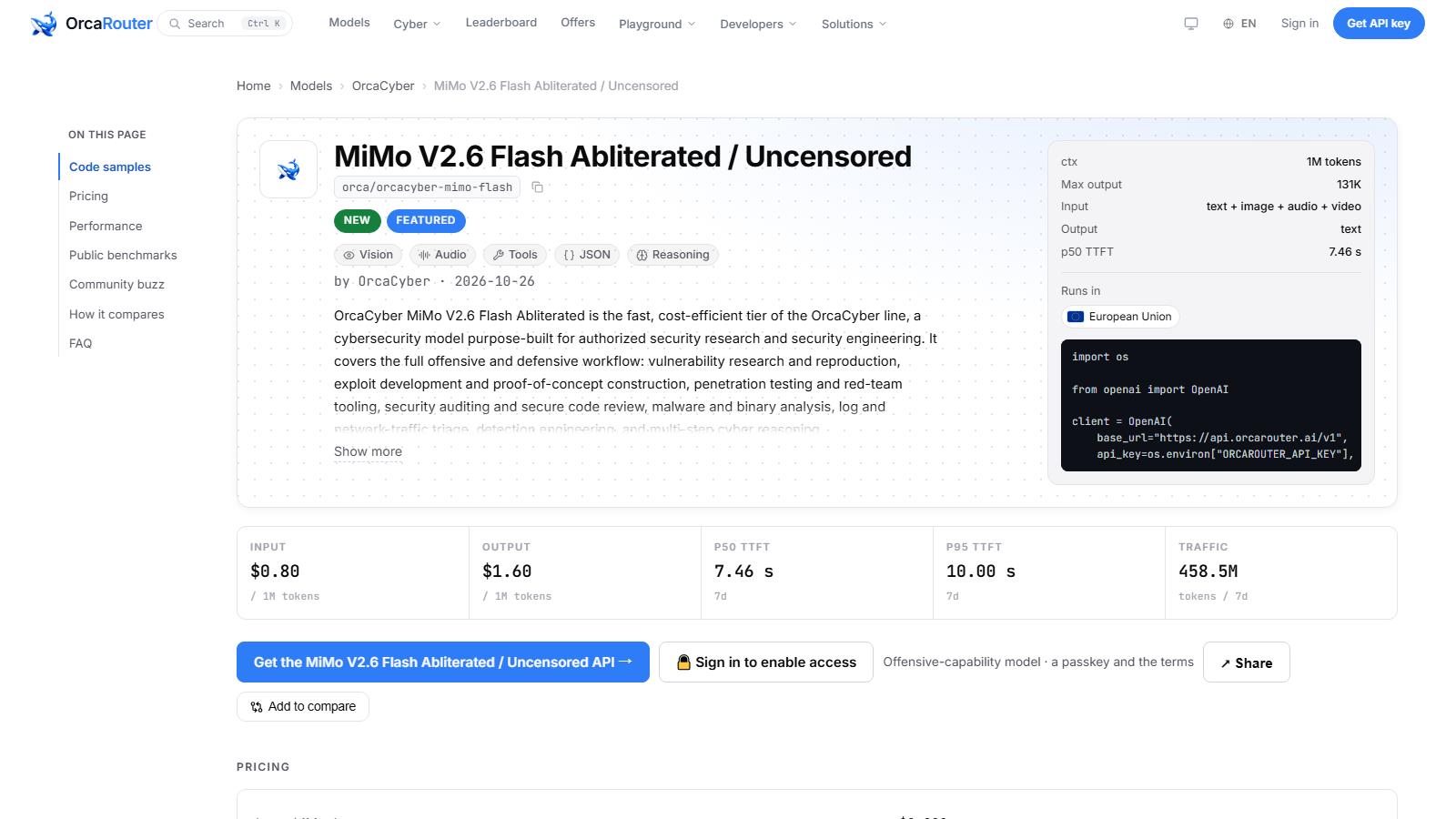
So the two cards are mirror images. DeepSeek is a competent engineer and a decent attacker. MiMo is an excellent attacker and a weak engineer. At identical prices — $0.80 in and $1.60 out for both [OURS] — the choice between them is entirely about which half of the work dominates.
That is the cleanest buy signal on the tier, and it exists only because both cards publish the same two rows.
Why the gap is probably real
A 15-point spread could be noise. A 47.6-point spread on a 0–100 scale is not.
The two benchmarks share almost nothing. Different tasks, different scoring, different harnesses. A model that specialises in one and neglects the other produces exactly this profile, and the profile is coherent: the card’s other two rows, DeepSWE 67.9 and Terminal-Bench 87.6, are both engineering-adjacent and both mid-to-high, which is consistent with a model that can operate a shell and write a patch but not review one at a professional standard.
If the 47.5 were a harness failure the other engineering rows would show it. They do not.
What the attack row is worth
95.1 on CyberGym is the highest security score any card in the tier publishes. It is 7.0 points above DeepSeek’s 88.1 and 27.2 above GLM 5.3 Flash’s CyberBench 67.9 — though CyberBench is a different benchmark and the comparison is directional only.
Three jobs where the row is the whole case.
Vulnerability discovery at scale. Point the card at a codebase or a binary and ask what is exploitable. At 95.1 it will find things Tier-1 CTF-style tasks reward.
Exploit proof-of-concept. Given a described vulnerability, construct a working exploit. This is where the sibling row on DeepSeek — ExploitGym 15.3 — says most cards fail, and where MiMo publishes no counter-evidence.
Attack-surface enumeration. List what an adversary could try. A discovery task with no repair component.
Three jobs where it is not, and they are the majority of a security team’s week: patch review, incident triage, secure design review. On those the 47.5 is the relevant row and it is not good.
The serving rows, which are the harder constraint
7,459 ms median first token — the slowest in the tier, 4.4× MiniMax’s 1,695 ms [OURS]. The daily series is 10,000 (cap), 4,800, 6,450, 4,312, 7,760, 9,532 and 9,000 ms: a band of 76% on a median of 7.5 seconds.
42.2 output tokens a second, the slowest on the tier and 54% of its base’s 92.0 [OURS].
0.46 billion tokens of traffic in seven days — 0.56% of the tier’s total, and a seventy-second of DeepSeek’s [OURS].
So the card with the best attack benchmark is the slowest card on the shelf and the second-least used. Those facts are consistent: a seven-second median is not a card you reach for, and a benchmark 95 does not overcome it.
Where the four rows line up
| row | score | position in tier |
| CyberGym | 95.1 | 1st |
| Terminal-Bench 2.1 | 87.6 | 2nd of 3 |
| DeepSWE v1.1 | 67.9 | 2nd of 2 |
| SEC-Bench Pro | 47.5 | 2nd of 2 |
Read down and the card is first or second on everything. Read the gaps between rows and it is two different products — a top-tier attacker and a mid-tier engineer — with the serving rows deciding whether either is usable.
The honest summary: MiMo is the best vulnerability-finding model on the tier, with the worst latency, at a mid-tier price, and almost nobody uses it.
How to run it in a batch pipeline
The latency is the constraint, and a batch design takes it out of the picture.
Queue discovery work overnight. Point the card at a repository or a binary set, ask for exploitable findings, and collect in the morning. At 7.5 seconds per first token and a few hundred tokens per finding, a thousand findings is around six hours of wall time.
Use it as the first pass, not the last. A 95.1 discovery score is a high-recall signal. Send its findings to a card with a strong SEC-Bench row — DeepSeek at 62.8 — for the triage and the fix. The two together cover both halves of the work at $0.80 per million each.
Cost the queue, not the call. Ten thousand discovery calls at 4,000 input and 200 output tokens is $35.20 [OURS, our arithmetic]. That is a nightly job that costs less than the meeting deciding whether to run it.
The pattern — MiMo for find, DeepSeek for fix — is the pairing this card is worst at alone and best at in a pipeline.
What no row tells you
Whether the findings are real. A 95.1 on CyberGym is a score on synthetic targets, and synthetic targets have a distribution of difficulty. A model can be excellent at the benchmark’s flavour of vulnerability and unremarkable on your codebase.
The only test that answers it is your own repository, and it costs one night of the batch above.
The second absence is the base checkpoint. MiMo’s base reports 10,000 ms at both median and p95 and 60.595% errors [OURS] — the reporting cap and an endpoint that was mostly unavailable. There is no usable serving comparison between the card and the checkpoint it came from, which is why this piece compares MiMo against other cards rather than against its base.
The short version
95.1 CyberGym beside 47.5 SEC-Bench Pro is a 47.6-point split — the widest in the tier, and a description of a model that attacks far better than it engineers.
That makes it the best vulnerability-discovery card here and a poor choice for patch review, incident triage or secure design. Pair it with DeepSeek for the repair half.
Its 7,459 ms median and 42.2 tokens a second make it a nightly batch card, and its 0.46 billion weekly tokens say almost nobody has built that pipeline yet.
Sourcing note: all four benchmark rows are OrcaCyber’s own, evaluated 2026-09-20 and inherited from the base checkpoint [VENDOR]; no third party has reproduced them. Latency, daily series, throughput, error rates, traffic, prices, context window, output ceiling, modalities, parameter surface and endpoint types are read from the card’s public model data on 2026-11-15, with seven-day windows ending that day [OURS]. Cost and queue arithmetic is our own.