Grocery shoppers expect enough room to navigate shelves, compare products, and move safely through store aisles. Yet restocking activity, temporary displays, and overlooked debris can introduce obstacles at foot level. A customer focused on finding an item may not notice a low object extending into the walking path until a foot catches on it.
These incidents are different from spills that cause slipping. A trip generally involves contact with an obstruction or uneven surface, and the exact object matters when determining responsibility. The following six hazards illustrate how everyday grocery operations can create risks—and why New York law requires a closer look at what the store knew and how the aisle was arranged.
1. Product Cases Extending Beyond Endcap Displays
Endcaps position merchandise at the ends of aisles, where shoppers frequently turn corners. Cases placed on low shelves may project farther into the walking route than the products above them. A low obstruction can be difficult to notice when someone is looking toward the next aisle.
In Grant v. Golub Corp. (2026), a New York appeals court examined a fall near an endcap holding cases of water. The court found that evidence of lower cases projecting into the aisle raised factual questions about whether the display was dangerous. The decision did not establish that every low display creates liability.
2. Restocking Boxes Left in the Walking Path
Employees may unpack shipments near the shelves being replenished. Sealed cartons, partially emptied boxes, or merchandise staged on the floor can narrow the usable walkway. The danger may be greatest when a box sits below the shopper’s natural line of sight.
Someone considering a claim may speak with a trip and fall injury lawyer from Towey Law in Buffalo about photographs, witness accounts, and whether store employees placed the obstruction. In Clayton v. Marcy Supermarket & Deli Corp. (2021), the court allowed a case involving low stacks of canned goods at an aisle end to proceed past the store’s dismissal motion. It did not determine ultimate liability.
3. Wooden Pallets Beneath Promotional Bins
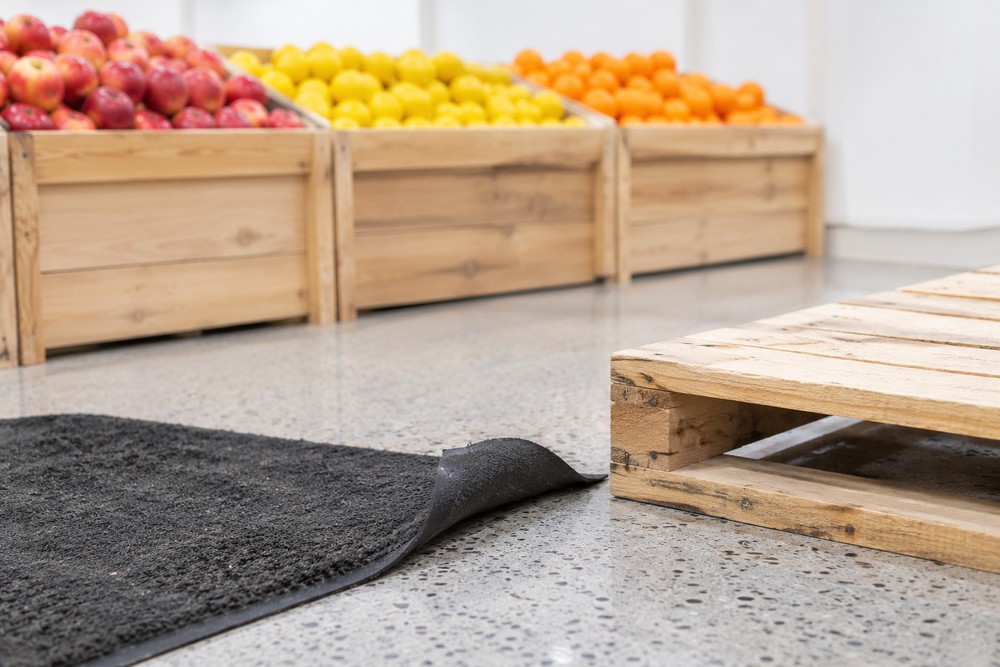
Bulk merchandise sometimes sits on wooden pallets beneath large cardboard containers. If the pallet extends beyond the bin, its edge may create a foot-level obstacle. Lighting, contrast with the floor, and the shopper’s familiarity with the display affect how visible that obstacle is.
A 2025 New York decision, Karlin v. K. Thompson Foods, LLC, illustrates the limits of these claims. The court concluded that the pallet and bin in that case were open, obvious, and not inherently dangerous. A pallet’s presence therefore does not automatically mean the store violated its duty.
4. Stocking Carts and Equipment in Narrow Aisles
Rolling stock carts, platform dollies, and other equipment help workers move heavy merchandise. When parked in customer areas, they can interrupt an expected path, particularly where shelves leave little room to maneuver. Their position and visibility are central to evaluating a fall.
In Baute-Mestre v. Stop & Shop Supermarket Co. (2026), surveillance evidence showed a dolly that the court found open and obvious and not inherently dangerous. The customer’s claim was dismissed. Other circumstances can differ, making evidence of aisle width, placement, and activity relevant rather than treating every cart as a defect.
5. Display Supports Hidden Beneath Lower Shelves
A display case can appear flush with its shelves while a support leg extends farther into the aisle. Customers looking at products may not notice hardware near the floor. Unlike a temporary carton, the obstacle may remain in the same place for extended periods.
In Moss v. Westside Supermarket LLC (2021), the court rejected a store’s request to dismiss a claim involving a display-case leg that allegedly caught a shopper’s foot. Photographs did not establish that the leg was plainly observable. Whether customers could reasonably detect a fixture is a fact-specific question.
6. Flattened Packaging and Discarded Cardboard
After restocking, flattened cartons and packing materials may remain on the floor. Their thin edges can catch footwear, especially when packaging blends into the floor. A clear aisle can change quickly as employees and customers handle goods.
But a floor-level object is not always legally dangerous. In DiScalo v. Mannix Family Market (2022), the court dismissed a claim involving a shopper who slipped on a flattened cardboard box because the evidence established it was readily observable and not inherently dangerous. Its reasoning shows why the appearance and circumstances of an obstruction matter.
What Must Be Shown Beyond the Trip Itself?
New York grocery stores generally owe customers a duty to keep premises reasonably safe. A case typically examines whether the store created the condition or had actual or constructive notice of it. Constructive notice generally requires a visible, apparent hazard existing long enough for employees to discover and address it.
A shopper’s actions may also be relevant. Under New York CPLR 1411, comparative fault can reduce damages without ordinarily eliminating recovery. The visibility of an object, however, must be evaluated with the full circumstances, not assumed from a photograph alone.
Evidence That Helps Reconstruct an Aisle Accident
A photograph taken soon after a fall may show the position of the obstruction before merchandise is moved. Store surveillance, incident reports, and witness accounts can help clarify how the hazard appeared and how long it remained there.
Useful records include:
- Images showing the object relative to shelves and walking space
- Names and contact details of witnesses
- The incident report and any available video
- Medical records describing the resulting injuries
- Receipts or other records establishing the visit
New York CPLR 214(5) generally provides three years for ordinary personal injury lawsuits, subject to exceptions. Prompt attention helps preserve evidence even when the filing deadline is farther away.
Why the Exact Obstacle Matters
Grocery store tripping hazards range from temporary delivery boxes to fixed display hardware. Each presents different questions about placement, visibility, notice, and the opportunity to prevent injury.
A Buffalo shopper’s case depends on evidence connecting a specific dangerous condition to the fall and identifying a legally responsible party. Understanding those details is more useful than assuming either that every obstruction creates liability or that a visible obstacle defeats a claim.