You might have a nice couch, good lamps, and newly painted walls, but your room still doesn’t feel complete. It could simply come down to what’s on the floor.
A rug will help add color to a bare room, making the floor feel softer and warmer. Plus, there are no tools required (or contractors, for that matter)!
If you’re looking at ways to update your home on a budget, investing in a rug is definitely one to consider – you just need to decide what you want the rug to do for the room first.
How one rug can instantly uplift a room
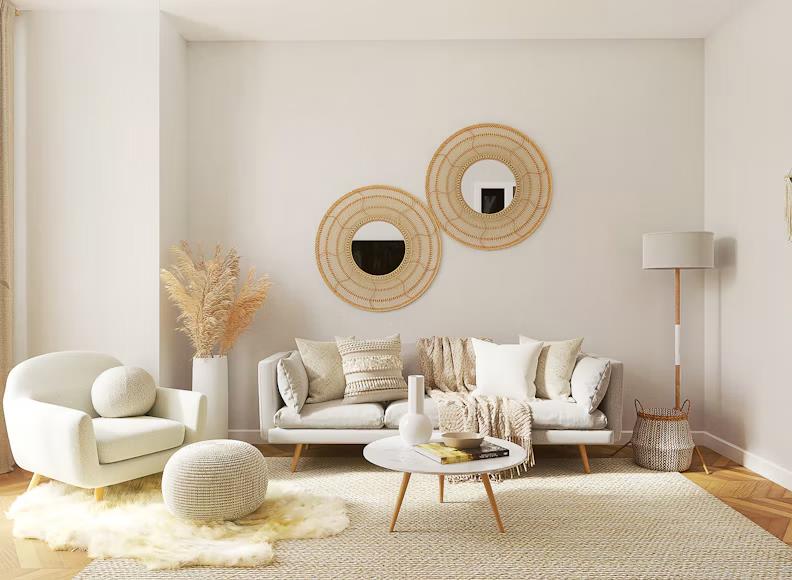
Consider a typical living room. You’ll probably have a couch, armchair(s), and a coffee table, each freestanding on the floor with no link between them.
Placing a rug under them will instantly unify these elements and create a ‘living room’.
Rugs are a common choice when uplifting interior spaces – a 2026 survey by Houzz found that among surveyed US homeowners on the site who renovated in 2025, 48% bought rugs as part of their interior decor purchases.
This can apply to any room of the house – be it to break up cold tiled flooring, add some variation to light-coloured floors, or demarcate an area within a larger room. A rug is a great way to assign functionality to a particular area.
Sizing an area rug
As mentioned, sizing a rug correctly is essential if you want to benefit from the effect above. Too small and it won’t serve much purpose other than being a coaster for your coffee table!
When selecting a size, think about how you want your furniture to interact with the rug and prioritize that over the quantity of exposed flooring. As a rule of thumb for living rooms, ensure the front legs of your couch/armchairs overlap onto the rug (though having them fully contained is also acceptable).
Before looking at rug shapes/sizes, measure the area you’d like to cover. You can then cross-reference this with the options available on a site like Rugs Direct and select one that’s appropriate for your space/requirements.
For example:
- For a living room, you want to encompass your key pieces of furniture, not just have the coffee table partially resting on top of the rug
- In a dining room, leave some clearance so the dining chairs can be pulled away from the table while still resting on the rug
- In a bedroom, leave enough rug visible on either side of the bed to step onto when waking up
You can also lay some tape on the floor to represent the boundary of the rug and move about to identify if anything seems disproportionate. This includes opening doors and moving chairs around, etc.
Finally, don’t forget to consider the shape of the rug, e.g. runners for a long corridor or a circular shape around a cozy nook.
Color and pattern considerations
Your rug does not need to have a flamboyant design to improve a room. Introducing a beige/off-white coloring can add warmth to a room, or alternatively a sage/duck egg blue hue to complement a scheme that’s otherwise fairly neutral.
Again, take note of colors currently in the room. A coloured/patterned rug will be ideal if your remaining furniture/decor is relatively plain, whereas you may want to stick to a simpler design if there is already plenty of color and patterns.
Try to incorporate at least one color in your rug that is present elsewhere in the room (e.g. a picture frame or timber feature), though this does not have to be a perfect color match.
The size of the pattern is worth factoring in as well – small motifs may appear plain from further away, whereas broader lines/motifs will be more pronounced. Try to view the rug from afar to assess how prominent it will appear in your room.
Similarly, different textures can dramatically alter the rug’s appearance – a smooth finish will give a more streamlined look, whereas a more organic/textured pile can lend itself to greater dimension. Consider how it looks in natural and artificial light before purchasing.
Selecting a rug material
Of course it’s tempting to fall in love with a rug you’ve seen online/in-store, but you’ll need to think practically about how you’ll use and care for it.
For instance, if the room sees high traffic / will be frequently walked over with trays of food/drinks, or occupied by children/pets, then you may want to select a more durable/harder-wearing material.
Wool makes a nice alternative to carpet in a lounge, whilst jute provides a nice natural aesthetic, but can feel rough under bare feet. There’s an abundance of man-made fibers to choose from; however, it’s always worth checking the maintenance requirements and expected longevity of the rug.
In a dining room/hallway, you’re generally better served by a flatter/thinner rug, rather than a plush pile that would trap debris and impede movement of chairs.
Note that “washable” may not extend to the whole rug in a domestic washing machine – check the instructions and confirm it’s feasible before assuming. The Carpet and Rug Institute advises choosing the right cleaning products and methods for carpets, rather than assuming any cleaning method will do.
Lastly, be sure to select the correct rug gripper to complement both your rug and underlying floor, and address any lifting corners/bunched edges separately so the rug enhances (not impedes!) ease of movement around it.
Working within your budget
When refreshing a room on a budget, it’s important to know exactly what each item you buy is achieving in your space. When purchasing a rug, you don’t necessarily have to spend a fortune to find something suitable.
Establish an overall budget, inclusive of rug + rug gripper + shipping costs (and make sure you understand the returns process if needed!). An inexpensive rug quickly becomes less attractive if you can’t return it economically.
When sourcing for your rug:
- Prioritize what is most important to you, i.e., fitting over the desired area of the floor and securing it in place. Compromise on other aspects, such as colour/pattern/material as required.
- Factor in other costs associated with the rug (cleaning, potential repairs, etc.) when assessing relative prices of similar rugs.
- Don’t forget to coordinate your existing furniture/decor to match/complement your rug – no need to go out and buy additional accessories!
There’s no point finding a cheap rug that isn’t functional or aesthetically pleasing to you in your space, so strike that balance of value and enjoyment of use.
After rolling the rug out in the room, leave it for a few days and see if there’s anything else that you feel the room lacks. Perhaps the rug alone is enough!
Summary
A rug can transform a space and instantly make it feel more homely and inviting, with minimal intervention required from you.
Having identified the key furniture/areas you want to anchor, simply find a suitably sized rug and choose a material that best suits its intended usage in your home. Add in your favorite colors and design elements to give it that extra flourish, and you’re good to go.
Sometimes the simplest changes can be all that’s needed to uplift a room.