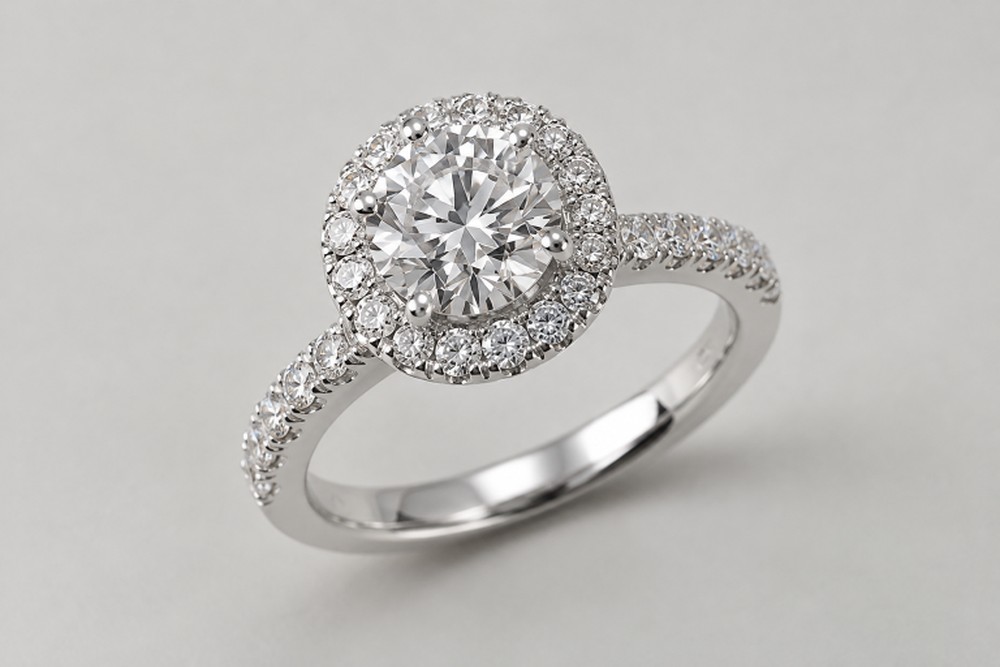
A halo engagement ring places a border of smaller diamonds around a center stone. That simple design choice can change the ring’s apparent size, sparkle pattern, outline, and overall personality. Whether the goal is a classic round halo or a more distinctive geometric frame, the setting should support the center stone rather than compete with it.
When comparing lab-created diamond halo rings from Gema&Co, pay attention to the ring from more than one angle. The face-up view reveals how the halo changes the center stone’s visible footprint, while the side view shows height, prong placement, gallery details, and how easily the ring may pair with a wedding band.
Why Halo Settings Stand Out
A traditional halo is a visible frame of closely set accent diamonds surrounding the main stone. It creates a wider field of light across the top of the ring and gives the center stone a new outline. A delicate halo can feel refined and romantic, while a sharply defined or double halo can look more dramatic. The result depends on the proportions, diamond shapes, metal color, and setting height.
How Halos Change Visual Size
Carat weight measures a diamond’s weight, not the amount of finger coverage it creates. A halo extends beyond the center stone’s edges, so the complete setting often appears larger from above without changing the center diamond’s carat weight. Halo width matters. A narrow, closely matched border can make the center seem more substantial, while an overly wide halo can make a smaller center stone look visually separated from its frame.
Consider the combined measurements of the center stone and setting, not just the carat number. A diamond’s cut and proportions influence its visible outline, while halo size, accent-stone scale, and band width determine whether the finished ring feels balanced.
Matching the Halo Shape to the Center Stone
The center stone’s outline sets the visual direction. A well-matched halo follows or intentionally contrasts with that outline in a way that still appears deliberate.
Round, Oval, and Emerald-Cut Stones
- Round stones pair naturally with round halos for a symmetrical, classic appearance.
- Oval stones create a generous length across the finger. A halo that closely follows the oval can preserve that elongated silhouette.
- Emerald-cut stones have straight edges and step-cut faceting, so a crisp, evenly aligned halo is especially important. A soft or uneven outline may distract from the stone’s clean geometry.
Radiant, Cushion, Pear, and Marquise Stones
- Radiant cuts bring sharper corners and a bright, lively appearance, while cushion cuts often suit softly rounded halos with a vintage-inspired feel.
- Pear and marquise stones produce a longer, more dramatic silhouette. Their pointed ends need secure protection, and the halo should be carefully shaped to maintain visual symmetry.
Halo Styles to Consider
- Single halo: A straightforward frame that increases sparkle and presence without adding too much visual complexity.
- Double halo: Two rows of accent stones that create a larger, bolder outline.
- Scalloped halo: A softly curved edge that can suggest floral or vintage styling.
- Geometric halo: A structured border suited to straight lines, angular stones, and Art Deco influence.
- Mixed-shape halo: A contrasting outline that can make the center stone look more individual, provided the proportions remain controlled.
Traditional Halo vs. Hidden Halo
A traditional halo is visible face-up and directly changes the ring’s apparent size. A hidden halo sits below the center stone, usually around the basket or gallery, and is seen mostly from the side or at an angle. Choose a traditional halo for a pronounced sparkle frame. Choose a hidden halo when a cleaner top view matters more, but a little extra detail is still welcome in the profile.
Choosing the Right Band
A plain band keeps the eye on the center stone and halo. A pavé band continues the sparkle down the finger, making the design feel more ornate. Neither is universally better. A slimmer band may make the top setting appear more prominent, while a wider band can provide a stronger visual foundation. Before committing, try the engagement ring beside a straight wedding band and, if needed, a curved or contoured band that fits around the center setting.
Metal Color and Contrast
White gold and platinum can create a blended, bright appearance around colorless diamonds. Yellow gold provides a warmer contrast, particularly when the prongs around the center stone are white metal. Rose gold can soften the overall effect. Compare metals against existing jewelry, skin tone preferences, and the desired level of contrast, because the metal can make the halo edge look either crisp or subtle.
Setting Proportions and Comfort
The center stone, halo, band, and gallery should work as one composition. Lower settings can be practical for daily wear because the center stone sits closer to the finger, although the exact comfort level depends on the design. Higher settings may make wedding-band pairing easier, but can create more exposed edges. Check prongs, pointed tips, and the underside of the setting before purchase. Small accent stones also benefit from regular inspection and careful cleaning.
Where Halo Styles Are Heading
Halo rings remain adaptable because the design can be tailored to a wide range of center-stone shapes and personal aesthetics. For 2026, focus less on chasing a single dominant look and more on selecting intentional details: an elongated center stone, a subtle hidden halo, a low-profile basket, a contrasting metal, or a more architectural frame. A style choice is most successful when it still fits the wearer’s routines and taste years later.
A Practical Buying Checklist
- Select the center-stone shape before finalizing the halo outline.
- Compare the ring’s total measurements, not carat weight alone.
- View the ring from the top, side, and three-quarter angle.
- Decide whether a plain or pavé band provides the right balance.
- Check wedding-band spacing and ask whether a contoured band may be needed.
- Include the setting, taxes, resizing, maintenance, and future repairs in the total budget.
- Review grading documentation when it is available.
- Confirm return, warranty, resizing, and repair policies before ordering.
Common Questions
Does a halo make a diamond look bigger?
It can make the complete ring look larger because the accent stones expand the visible outline. The center diamond’s actual carat weight does not change.
Which center-stone shape works best with a halo?
There is no single best option. Round, oval, cushion, emerald, pear, marquise, and radiant stones can all work well when the halo is sized and aligned carefully.
What is the difference between halo and pavé?
A halo is the frame around the center stone. Pavé describes small stones set closely together along a band or another part of the ring.
Is a hidden halo visible from the top?
Usually, it is designed to be seen primarily from the side or at an angle rather than as a full border around the center stone.
How should a halo ring be cleaned?
Gentle cleaning and periodic professional checks help keep small accent stones secure. The recommended diamond cleaning practices include using mild soap, warm water, and a soft brush, while avoiding harsh chemicals and checking settings regularly.
Conclusion
A halo setting is more than an added sparkle feature. Its shape, width, metal, center stone, band, and profile all contribute to the finished ring’s character. The strongest choice is not automatically the largest or most detailed design. It is the one that creates the desired visual impact while remaining comfortable, durable, and true to the wearer’s personal style.